Peptide High Quality: Significance Of Third-party Validation
@edwinvfrb167
Peptide Purity & Quantitation Testing
To conclude, recognizing peptide purity degrees and grades assists you make notified choices for your experiments. A peptide's pureness portion informs you how much of that sample is the real offer versus byproducts, with typical research study grades being around 95% up to 98-99% for added purity. Analytical HPLC and MS are your pals below-- HPLC quantifies purity, and MS validates identification, with each other ensuring you recognize what remains in your tube.- The chromatographic pureness is then determined by contrasting the location under the main top with the complete area under all integrated tops.
- We collaborate with biotech, pharmaceutical, CRO, CDMO, and scholastic teams on peptide chemical and physical analyses that sustain research and non-clinical choice making.
- This degree of information helps researchers comprehend if any small peptide by-products exist.
- It also sustains traceability-- each batch's laboratory validation report can be tied to its COA and regulative filings, creating a clear paper trail.
Shop Coa-verified Research Peptides
HPLC tells you what proportion of your sample is the major compound-- yet it does not confirm what that main substance really is. A peak with the appropriate retention time can theoretically be a relevant peptide with comparable hydrophobicity. Mass spectrometry provides identity confirmation by gauging molecular mass directly. We evaluate peptide length, series make-up, expected molecular weight, modification kind, salt form, sample history, and intended downstream usage before defining the analytical course.
As the percent of natural solvent progressively enhances during the run, particles are launched from the column in order of their hydrophobicity-- the more hydrophobic a peptide, the longer it takes to elute (clean off). Given that pollutants generally differ from the target peptide by at least one amino acid, they have somewhat different Direct-SARMs hydrophobicities and show up as separate peaks on the chromatogram. The bottom line is not to puzzle purity (HPLC percentage of the main peptide vs contaminations) with overall web content. For speculative preparation (like computing molar focus), both purity and web content work numbers, however pureness is what reflects the chemical homogeneity of the peptide example.Innovative Peptides suggests a series of different purity levels to aid you select the best peptide purity for peptide-based assays and applications. The following checklist reveals the suggested peptide pureness levels needed for different peptide applications. Peptide recognition is mostly carried out utilizing mass spectrometry (MS), which supplies precise measurements of peptide molecular weight. Additionally, techniques such as amino acid evaluation and HPLC are utilized to validate the peptide's identification and purity, guaranteeing precise characterization for numerous applications. We provide peptide identification verification making use of mass-based techniques chosen for the example and analytical purpose. This is necessary when the main concern is whether the observed component matches the designated peptide or whether an adjustment has actually been integrated as expected.
Why Should Researchers Require Third-party Validation?
Examinations can be carried out using high-precision stablizing chambers, simulating different settings, and using worldwide standards to examine short-term and long-lasting security, vital for consistent peptide performance. Some peptides stop working not because the series is wrong, but due to the fact that their physical habits in real solvents is inadequately understood. We supply physical building screening that helps groups function more effectively with challenging samples. Mass spectrometry confirms whether the gauged mass matches the anticipated peptide mass. The chromatogram is the most essential aesthetic information aspect on an HPLC peptide test report. It is a chart with time on the straight axis and detector action, typically UV absorbance, on the upright axis.
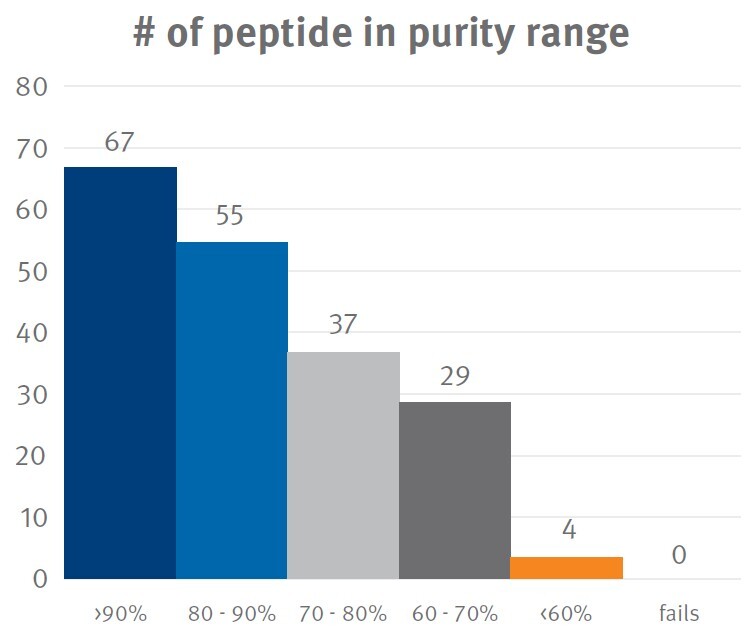
The software application draws limits around each optimal and calculates the area underneath. The purity percentage originates from comparing the location of the primary top to the overall location of all identified optimals. Most records consist of a table listing each top's retention time, location, and portion of total location.
The most stringent grade, including mindful HPLC filtration-- in some cases multiple rounds-- and strenuous QC. Required for measurable researches, architectural biology, in vivo study versions, and any kind of application where even small amounts of contamination could influence results. This is the quality where the cost increases most dramatically, since attaining that last 1-- 3% of pureness needs throwing out a significant fraction of the synthesized material. A removal peptide missing a solitary residue may still bind to the exact same receptor, however with various fondness or selectivity. In concentration-response experiments, these contaminants can shift curves, flatten plateaus, or introduce biphasic behavior that obscures the true task of the target compound. The isoelectric factor (masterpiece) is an important specification for comprehending peptide solubility and actions in numerous atmospheres.